
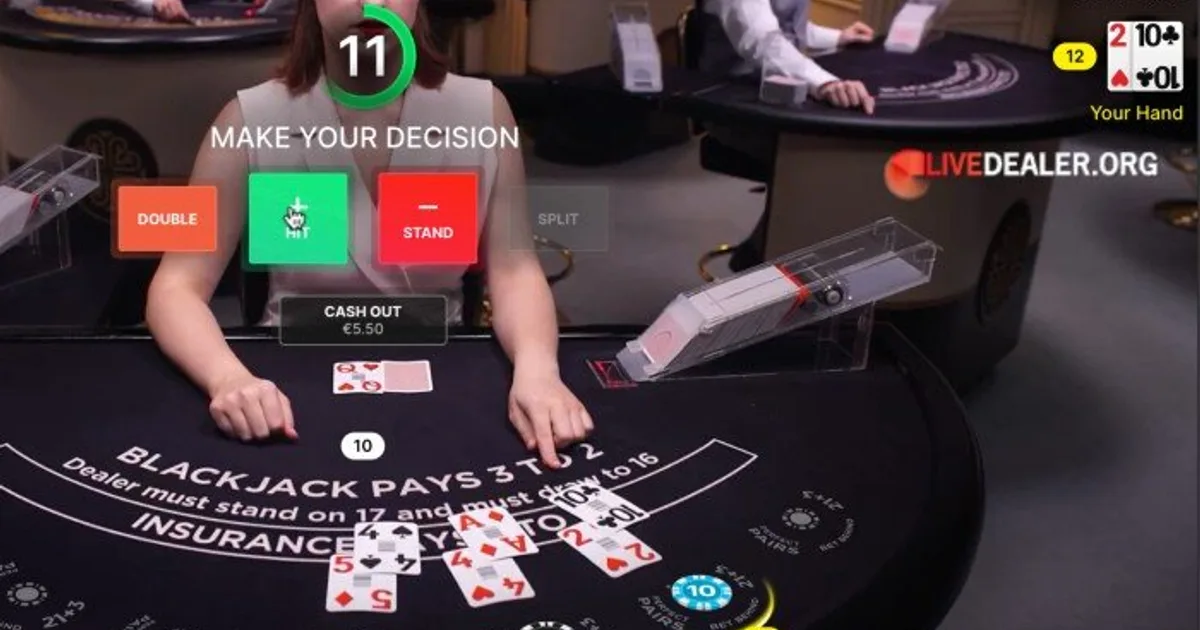
Among all casino games hosted on physical casino floors and digital live dealer streams, Blackjack (traditionally known as Twenty-One) holds an exceptional mathematical status. While games such as roulette, baccarat, and slot machines rely entirely on chance and rigid drawing rules, blackjack directly empowers the player with meaningful decisions on every single hand. Every choice to hit, stand, double down, or split pairs directly alters your statistical outcome.
When played with mathematical precision using Basic Strategy, blackjack boasts one of the lowest house edges in the entire casino industry—often dipping below 0.50%. Across Philippine online casino platforms, live dealer blackjack tables broadcast professional dealers in real time, offering authentic physical card play, multiple side bets, and flexible table limits.
Whether you are learning the card scoring rules for the first time or seeking to eliminate costly strategic errors, mastering the mechanics of live dealer blackjack is essential. This comprehensive guide covers official table rules, dealer drawing constraints, the mathematically optimal basic strategy chart, side bet risks, bankroll preservation, and verified cashout procedures.
Technical Specifications and Table Overview
Before placing your first wager on live dealer blackjack felt, reviewing the standard shoe parameters provides an objective perspective on the game's rules:
| Rule Dimension | Standard Live Table Rule | Practical Player Impact |
|---|---|---|
| Shoe Size | 8 Standard 52-Card Decks (416 Cards) | High card volume reduces shoe penetration volatility |
| Blackjack Payout | 3:2 Payout (Avoid 6:5 Tables) | A PHP 100 bet on natural 21 pays PHP 150 profit |
| Dealer Drawing Rule | Dealer Stands on All 17s (S17) | Statistically favorable for the player |
| Double Down Rules | Allowed on Any Initial Two Cards | Enables aggressive doubling on favorable dealer upcards |
| Splitting Pairs | Split up to 4 Hands (Aces Split Once) | Maximizes edge on matching pairs like 8-8 and A-A |
| Theoretical House Edge | Approximately 0.45% to 0.60% | With basic strategy, delivers the highest player return in the casino |
| Round Duration | 45 to 60 Seconds per Hand | Provides ample time to consult strategy charts |
| Betting Limits | PHP 50.00 to PHP 25,000.00+ per Hand | Accommodates casual recreational strategists and VIP card players |
The Core Objective and Card Valuation Rules
The primary objective of blackjack is frequently misunderstood by beginners. The goal is not simply to reach as close to 21 as possible; rather, your goal is to beat the dealer's final hand total without exceeding 21.
[Place Initial Wager] ──> [Two Cards Dealt to Player & Dealer] ──> [Player Makes Strategic Choices] ──> [Dealer Reveals & Draws] ──> [Payout Settled]
Card Point Values in Blackjack:
- Cards 2 through 9: Retain their exact numerical face value (e.g., a 4 is worth 4 points; an 8 is worth 8 points).
- Tens, Jacks, Queens, and Kings: Count as 10 Points each.
- Aces: Represent dynamic dual-value cards, counting as either 1 Point or 11 Points, whichever benefits your hand more.
Understanding Hard Hands vs Soft Hands:
- Hard Hand: A hand that contains no Ace, or where an Ace must count as 1 point to avoid exceeding 21 (e.g., 10 + 7 = Hard 17; 9 + 8 = Hard 17; Ace + 6 + 9 = Hard 16). Hard hands risk "busting" if you draw another high card.
- Soft Hand: A hand containing an Ace that can be counted as 11 points without busting (e.g., Ace + 6 = Soft 17; Ace + 4 = Soft 15). Soft hands provide flexibility because drawing a high card simply converts the Ace to a 1-point value rather than causing an immediate bust.
Player Action Choices on Every Hand
Once the dealer distributes two face-up cards to you and reveals one face-up card for themselves (the Dealer Upcard), you are presented with several strategic choices:
Hit (Draw a Card)
You request an additional card to increase your total. You may continue hitting as many times as you wish until you either choose to stand or exceed 21 (resulting in an immediate Bust and loss of your wager).
Stand (End Your Turn)
You are satisfied with your current card total and choose to draw no further cards. Your turn concludes, and the action moves to the next player or the dealer.
Double Down (Double Your Stake)
If your initial two cards total a favorable sum (such as 9, 10, or 11) while the dealer displays a weak upcard (such as a 4, 5, or 6), you can double your original wager. In exchange, the dealer delivers exactly one final card to your hand and automatically ends your turn.
Split Pairs (Divide Matching Cards)
If your initial two cards possess the identical rank (such as two 8s, two 7s, or two Aces), you can place a secondary wager equal to your initial bet to split them into two independent hands. The dealer separates the cards and deals a second card to each, allowing you to play both hands separately.
Surrender (Late Surrender)
On select live tables, if your initial two cards form a poor total (such as 16 against a dealer Ace or 10), you can forfeit your hand, conceding half your wager while preserving the remaining 50% of your stake.
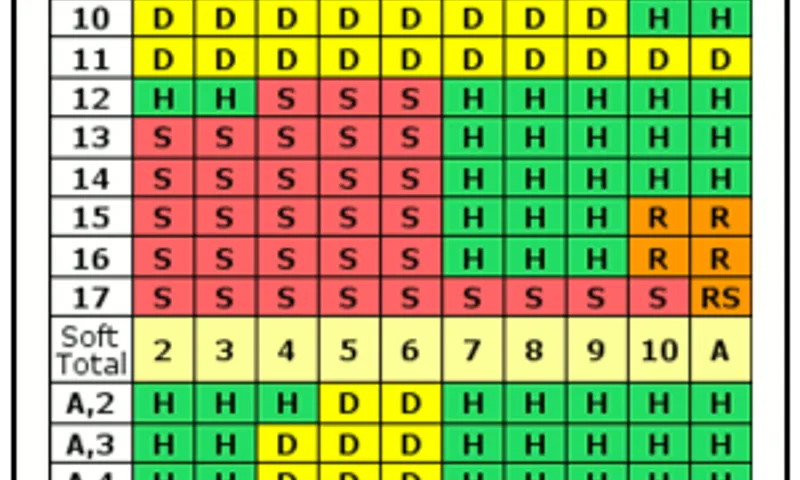
Complete Basic Strategy Decision Matrix
Basic strategy is not a matter of guesswork, intuition, or luck; it is a mathematically proven system derived from computer simulations analyzing all possible combinations of player hands against every possible dealer upcard. Adhering to basic strategy reduces the house edge to its absolute mathematical minimum:
Hard Total Strategy Guidelines:
- 8 or Lower: Always Hit regardless of what the dealer shows.
- 9: Double Down if the dealer shows 3, 4, 5, or 6. Otherwise, Hit.
- 10: Double Down if the dealer shows 2 through 9. If the dealer shows a 10 or Ace, simply Hit.
- 11: Double Down against any dealer upcard from 2 through 10. If the dealer shows an Ace, simply Hit.
- 12: Stand if the dealer shows 4, 5, or 6. Otherwise, Hit (the dealer is likely to bust on 4, 5, or 6).
- 13 through 16: Stand if the dealer shows 2 through 6. Hit if the dealer shows 7, 8, 9, 10, or Ace.
- 17 or Higher: Always Stand. Never hit a hard 17 or above.
Soft Total Strategy Guidelines:
- Soft 13 or 14 (Ace + 2 or Ace + 3): Double Down against dealer 5 or 6; otherwise Hit.
- Soft 15 or 16 (Ace + 4 or Ace + 5): Double Down against dealer 4, 5, or 6; otherwise Hit.
- Soft 17 (Ace + 6): Double Down against dealer 3 through 6; otherwise Hit.
- Soft 18 (Ace + 7): Double Down against dealer 3 through 6. Stand against dealer 2, 7, or 8. Hit against dealer 9, 10, or Ace.
- Soft 19 or Higher (Ace + 8 or Ace + 9): Always Stand.
Pair Splitting Guidelines:
- Always Split Aces and 8s: A pair of Aces gives you two chances at a natural 21, while a pair of 8s forms a terrible hard 16 that improves dramatically when split into two hands starting with 8.
- Never Split 10s or 5s: A pair of 10s gives you a commanding total of 20, which wins over 85% of hands. A pair of 5s should be treated as a hard 10 and doubled down against dealer 2 through 9.
- Split 2s, 3s, and 7s: Split against dealer upcards 2 through 7; otherwise hit.
- Split 4s: Only split against dealer 5 or 6 if doubling after split is allowed; otherwise hit.
- Split 6s: Split against dealer 2 through 6; otherwise hit.
- Split 9s: Split against dealer 2 through 6, 8, and 9. Stand if the dealer shows a 7 (your 18 beats their probable 17), 10, or Ace.
Why You Should Never Take the Insurance Bet
When the dealer's visible upcard is an Ace, the digital interface will prompt all players: "Insurance? (Pays 2:1)".
- How Insurance Works: You place a side bet equal to half your original wager. If the dealer's hidden hole card is a 10-value card (giving the dealer a Natural Blackjack), your insurance bet pays 2:1, offsetting the loss of your primary wager.
- The Mathematical Reality: In an 8-deck shoe, there are 416 cards, of which 128 are 10-value cards (Tens, Jacks, Queens, Kings). The mathematical probability of the dealer's hole card being a 10 is only 30.8%.
- Over time, taking insurance gives the casino an enormous house edge of approximately 7.40%.
- The Professional Rule: Always decline the Insurance bet. It is mathematically disadvantageous for non-card counters.
Card Counting Realities in Online Live Dealer Games
Many players wonder whether legendary card counting systems (such as the Hi-Lo system) can be deployed to beat online live blackjack:
In land-based casinos, card counters track the ratio of high cards (10s and Aces) to low cards (2 through 6) remaining in the shoe. When the shoe becomes rich in high cards, counters raise their bets because the player gains a mathematical advantage.
However, in online live dealer casinos:
- Dealers typically deploy an 8-deck shoe and place the plastic cut card roughly at the 50% shoe penetration mark (after 4 decks).
- Once four decks are dealt, the shoe is removed and reshuffled immediately.
- Because the shoe is reshuffled halfway through, the count never reaches the deep positive territory required to overcome the house edge.
- Therefore, rely strictly on Basic Strategy rather than trying to count cards on digital streams.
Bankroll Management for Live Dealer Tables
Because blackjack involves doubles and pair splits that require placing secondary wagers during the hand, proper bankroll sizing is critical:
The 40-Bet Rule
Ensure your active session bankroll equals at least 40 times your base table bet:
- For a PHP 2,000 session bankroll: Your base bet should be PHP 50 per hand.
- For a PHP 5,000 bankroll: Bet between PHP 100 and PHP 125 per hand.
- This capital buffer ensures that when you are dealt a pair of 8s against a dealer 5, you have ample funds to split and double down without straining your balance.
Avoiding "Gut Feeling" Deviations
The most common mistake among amateur players is abandoning basic strategy based on "hunches"—such as hitting a hard 13 against a dealer 5 because they "feel a small card coming." Every deviation from basic strategy mathematically increases the casino's house edge. Trust the simulated mathematics on every single hand.
Mobile Play and Payout Procedures
Live blackjack streams are fully accessible across mobile devices in the Philippines:
- Clear Optical Card Sensors: Cards feature oversized indices that are scanned by optical RFID sensors on the table, displaying digital representations of your cards on screen to prevent misreading small physical cards on mobile displays.
- Instant Cashier Settlements: Licensed platforms support instant deposits and cashouts through authorized Philippine e-wallets, including GCash and Maya. Approved withdrawals are dispatched to personal wallets within 15 to 45 minutes, complying with regulatory oversight from PAGCOR and financial directives enforced by the Bangko Sentral ng Pilipinas.
Responsible Gaming Commitment
Blackjack is a game of skill and probability, but it remains a gambling activity with inherent financial risk. No strategy chart can guarantee winning sessions. Always gamble responsibly, set strict loss boundaries, and never wager funds needed for household essentials. If you require support regarding your gaming habits, seek free, confidential assistance through Gamblers Anonymous or Gambling Therapy.
Frequently Asked Questions
What does "Soft 17" mean in blackjack?
A Soft 17 is a hand containing an Ace valued at 11 alongside a 6 (e.g., Ace + 6). In basic strategy, players should never stand on a Soft 17; you should always double down if the dealer shows 3 through 6, or hit if the dealer shows any other card.
Why should you always split a pair of 8s?
A pair of 8s totals a hard 16, which is statistically the worst starting hand in blackjack. By splitting the 8s, you break apart a losing 16 and create two fresh hands, each starting with an 8, which carry significantly higher chances of winning.
What is the payout for a Natural Blackjack?
On standard player-friendly tables, a Natural Blackjack (Ace + 10-value card on the deal) pays 3:2 (e.g., PHP 150 profit on a PHP 100 bet). Avoid tables that pay 6:5, as that payout reduction increases the house edge by more than 1.3%.
Does the dealer have to hit on 16?
Yes. Under standard casino rules, the dealer has no discretionary choices and must hit all hands totaling 16 or lower, continuing to draw until reaching at least 17 or busting.
Can I play live dealer blackjack on my smartphone?
Yes. Modern live casino platforms provide fully optimized mobile web and app interfaces where you can view the dealer video stream and tap on-screen buttons to hit, stand, double, or split.
Related Guides & Silo Navigation
- Return to Live Dealer Casino Hub — Explore baccarat, roulette, and game shows.
- Live Dealer Baccarat Strategy Guide — Roadmap reading and Banker odds.
- Evolution Gaming Studio Overview — Crazy Time and Lightning tables.
- MILYON88 GCash Deposit Tutorial — How to fund your balance via mobile QR.
- Fast Cashout and KYC Verification — Complete cashout requirements.